Letter · 22 Nov 1915 · Cairo, Egypt
Billions of maddening flies
IWI: Ngāti Tūwharetoa and Tuhourangi HAPŪ: Ngāti Rauhoto WAKA: Te Arawa. Harry was born at Taupo, went to primary school in Rotorua, then studied in Auckland at Auckland Grammar. He completed his degree in engineering at Canterbury University. For his full bio, see: http://www.teara.govt.nz/en/biographies/3d2/dansey-harry-delamere Here is Te Ara's summary of his war service: Harry Dansey was nearly 40 years old when war broke out. Despite having a reserved occupation, he enlisted. He sailed in the second draft of the Maori Contingent, and held the rank of second lieutenant. On arrival in Egypt he was posted to the Otago Infantry Regiment as a machine-gun specialist. In the reorganisation that followed the Gallipoli campaign, he was transferred to the New Zealand Pioneer Battalion. Promoted to lieutenant, he served as a Lewis machine-gun officer in France. By January 1917 Harry had been mentioned in dispatches and was appointed second-in-command of a company in the field. His engineering qualifications were to prove invaluable. The following month, seconded for duty as II ANZAC Corps (later XXII Corps) tramway superintendent, he was placed in charge of railway construction and transport organisation for the battle area. The evacuation of wounded troops was also his responsibility. He was promoted to captain in April, and in January 1918 he was awarded the Military Cross for 'distinguished services in the field'. From 2 October until 26 December 1918 he performed the duties of bridging officer, XXII Corps.
Extracts from this letter
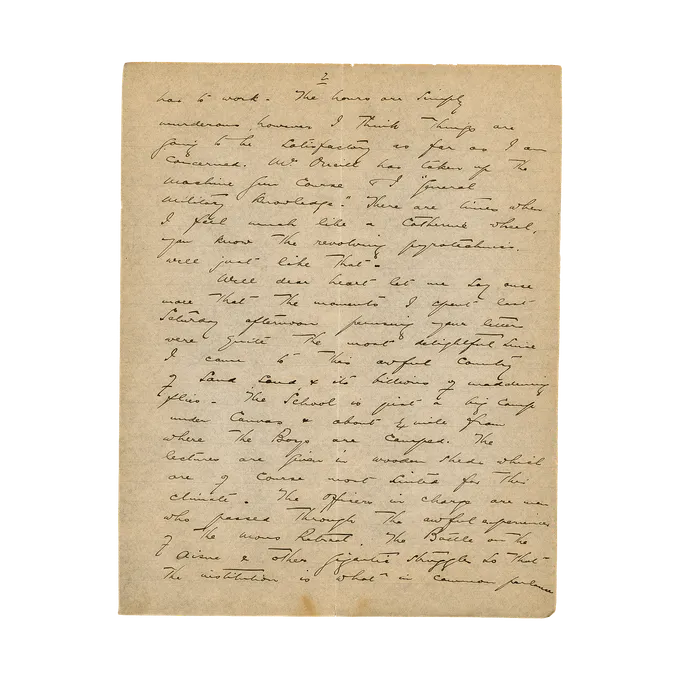
"Well dear heart let me say… that the moments I spent last Saturday afternoon perusing your letter were quite the most delightful since I came to this awful country of sand and its billions of maddening flies."
"The school is just a big camp under canvas… The lectures are given in wooden sheds which are of course not [made] for this climate…"
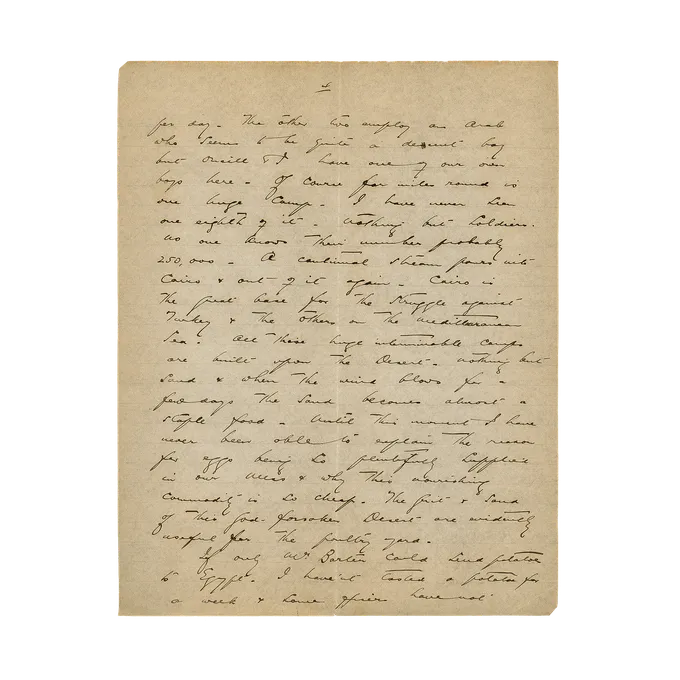
"For miles around is one huge camp. I have never seen one eighth of it – nothing but soldiers, as one knows their number is probably 250,000. A continual stream passes into Cairo and out of it again. Cairo is the great base for the struggle against Turkey and the others on the Mediterranean Sea."